
Memory & Context
Can AI memory trap you in your past decisions?
Short answer
Yes, if memory turns your history into automatic recommendations. Useful memory should restore past context and outcomes without treating old decisions as instructions for the present.
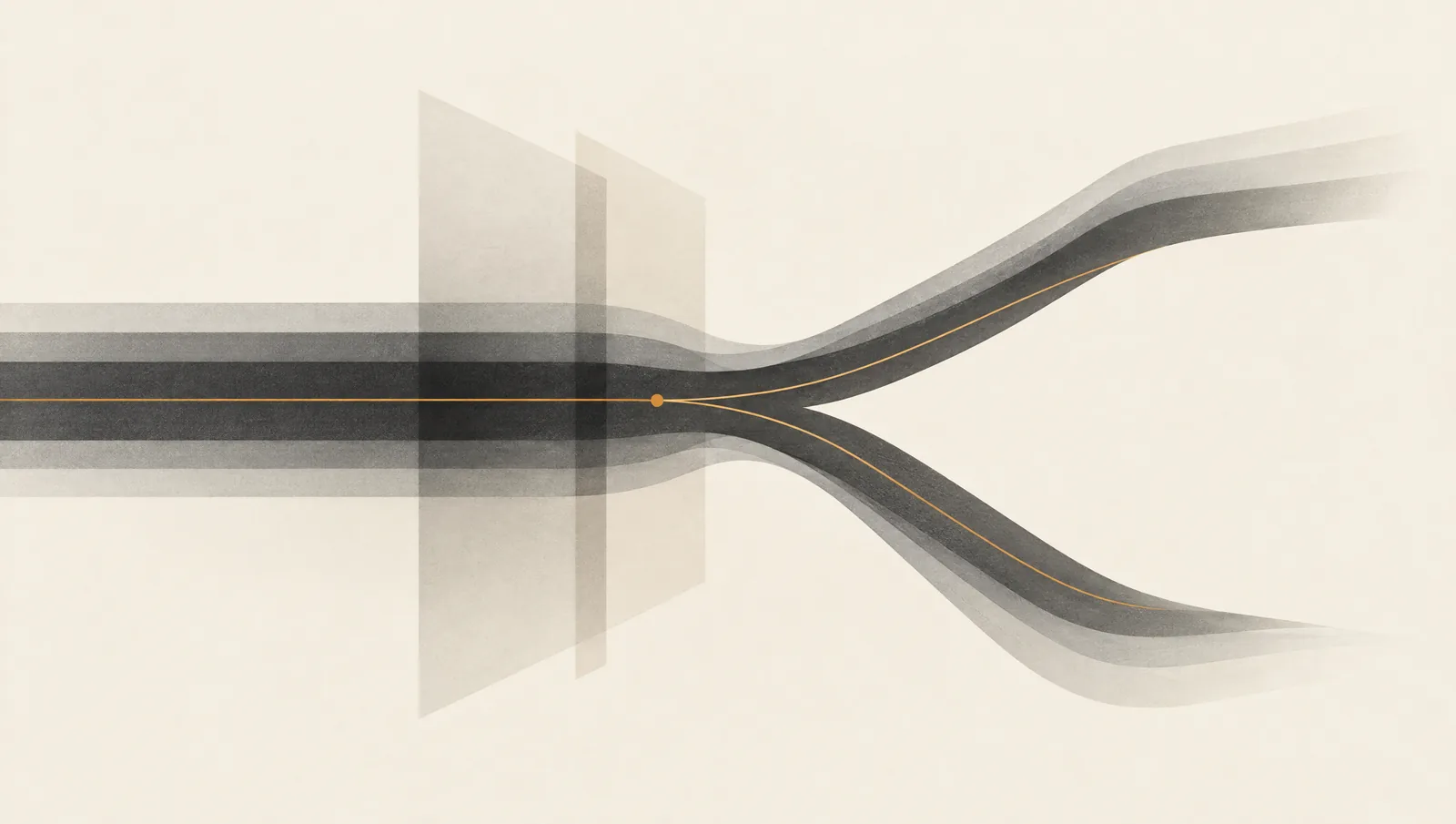
Memory is often presented as a solution to forgetting.
But remembering everything can create a different problem: repeating the past.
If AI knows your previous decisions perfectly, it may be tempted to assume that the best recommendation is the one most similar to what you already did.
That is not what memory should do.
A past choice is not an eternal preference
You may have chosen a supplier because cash was tight.
Six months later, that constraint may be gone.
You may have preferred the city center before working from home three days a week.
You may have rejected a technology because nobody on the team could maintain it.
Then the team changed.
Memory needs to make those changes visible.
The reason protects against conservatism
Past decisions become dangerous when they are retrieved without the reason behind them.
“We chose X” starts to look like a rule.
“We chose X because of Y, under conditions Z” becomes context.
That difference matters.
The reason lets the AI ask whether the conditions still apply.
Outcomes matter as much as intentions
A decision may have looked excellent and later produced a poor result.
If memory only preserves the initial choice, it freezes an incomplete version of the past.
Preserving the observed outcome makes it possible to reopen the reasoning.
Memory then becomes a learning tool rather than a catalogue of precedents to repeat.
A concrete example
A year ago, you rule out a management tool because nobody knew how to configure it. Today, someone on the team does. An AI that only recalls “you ruled out this tool” pushes you not to look at it again.
An AI that recalls “you ruled it out because nobody knew how to configure it” lets you check whether that reason still holds. Same memory, two effects.
AI should not decide for you
Historical context can improve reasoning.
It should not become a hidden instruction.
A useful answer might say:
“You chose this option before for these reasons. Two of those conditions have changed, so the decision deserves a fresh look.”
It should not say:
“You have always done this, so keep doing it.”
Continuity without inertia
The goal is not to restart from zero.
The goal is not to become trapped by history either.
Useful memory holds both ideas at once:
- your past experience should remain available;
- your present decision remains open.
To retrieve your trade-offs without obeying them, read how an AI can retrieve your own trade-offs without deciding for you. For decisions that change, see when a decision changes, what happens to the old one?. Repetitions are covered in can you detect decision cycles without psychologizing the user?, and the value of reasons in why preserve the reasoning behind a decision.
Limits of this vigilance
Recalling the reasons for a choice does not prevent mistakes: the AI may also judge that a condition has changed when it still holds. Judgment remains yours, and a memory that sends your past back to you is never neutral about what it chooses to recall.