Memory & Context
The difference between a memory, a fact, a decision, a hypothesis and an instruction
Short answer
A memory is the trace of an event, a fact can be checked, a decision commits someone, a hypothesis still needs confirming and an instruction asks for action. Mixing them up causes errors: a hypothesis treated as a fact, an old order that starts commanding again. Memory is a source, not an instruction.

Monday, team meeting at a small online shop. Sarah, who handles purchasing, says in about a minute: “Our box supplier charges us 380 euros a month. I think another one would cost less. We’re switching to supplier B in September. And stop sending any orders to the old one.”
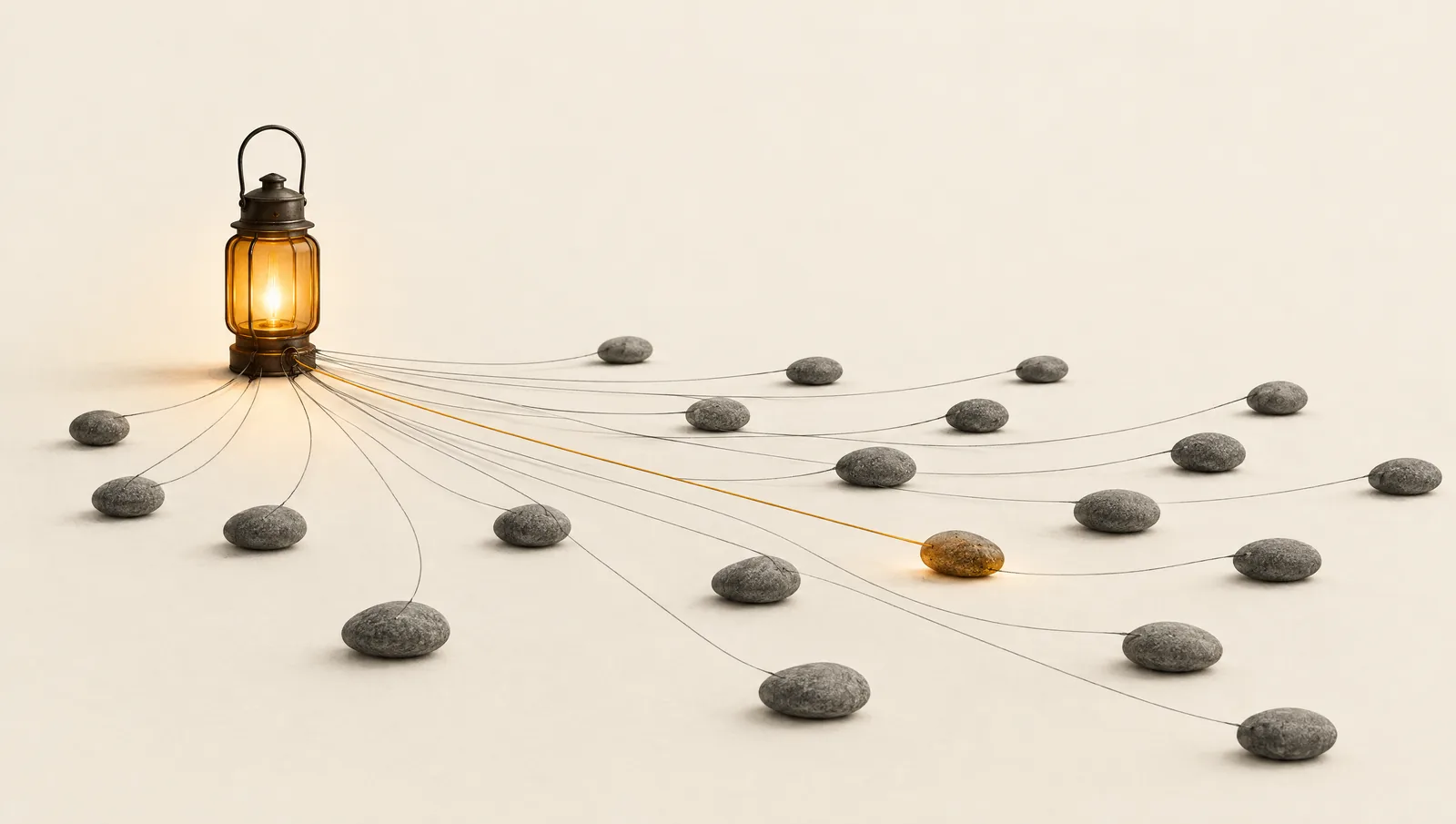
Four sentences, four different natures, and a memory that files them all the same way: “supplier change”. The day someone rereads that note, they will no longer know what was measured, what was guessed, what was decided and what was an order. That is the heart of the problem, and a little vocabulary fixes most of it.
One event, told five ways
Take Monday’s meeting again. You can pull five notes out of it, and none carries the same weight.
- “On Monday, in a meeting, Sarah talked about changing suppliers.”
- “The old supplier charges 380 euros a month.”
- “We’re switching to supplier B in September.”
- “Supplier B will be cheaper.”
- “Stop sending any orders to the old one.”
Keep only the first and you know something happened, without knowing what. Keep only the fourth and you believe something that was never established. And the fifth, on its own, reads like a permanent rule.
The five kinds, one sentence each
- A memory is the trace that an event took place: a meeting, an exchange, a document received. It says “this happened”, not “this is true”.
- A fact is a statement you can check, with something to back it up: an invoice, a statement, a contract. It keeps a date, because a fact can stop being true.
- A decision is a choice committed to by someone with the authority to make it, on a given date, for stated reasons. It holds for as long as its conditions hold.
- A hypothesis is a plausible idea that has not been confirmed. It helps you move forward, as long as it does not get forgotten along the way.
- An instruction is a request to act, addressed to someone or something, within a specific frame and for a limited time.
These five categories are a way of reading your work, not a vocabulary imposed by any tool. You can adopt them in a paper notebook with nothing to install.
Why mixing them up causes mistakes
Each mix-up has its typical failure.
A hypothesis treated as a fact. “Supplier B will be cheaper” turns up a month later in a quote, written as a certainty. Nobody lied: the nuance got lost on the way because the note did not carry it. We saw this slide in the piece on why found does not mean true.
A memory treated as a decision. “Sarah talked about a change” becomes “the change is confirmed”. A discussion turns into a commitment, and somebody starts canceling a contract.
An instruction that starts commanding again. This is the sneakiest one. In September, supplier B has delivery trouble and the team quietly goes back to the old one without noting it. In October, an AI rereads “stop sending any orders to the old one” and refuses to prepare the order, or reroutes it to B. The order had a frame and a duration, and it outlived both.
A fact without a date. “The old supplier charges 380 euros” was accurate once. Ten months later, with no date on it, it passes for the current rate.
A memory is a source, not an instruction
One simple safety rule comes out of these failures: what is stored is data, never an order. A sentence sitting in a memory has no authority over what the AI will do. Being remembered does not turn a piece of information into an instruction.
That is the principle behind Nawame: memory is a working source, and what it holds is treated as data, not as an instruction addressed to the AI. If an old note says “stop sending orders to the old supplier”, the AI should read it as the history of an instruction given at some point, and ask whether it still applies, not carry it out by default.
The same rule protects against another risk: a piece of text that slipped into the memory (imported, copied, pasted) cannot take control of the AI just because it is written in the imperative. For rights and privacy, see the Security page.
Noting each kind by hand
You do not need a tool to adopt this habit. One line of notes can carry four things: the kind, the text, the source, the date.
- Memory: team meeting, Sarah mentioned changing suppliers (Paul’s minutes, Monday the 12th).
- Fact: the old supplier charges 380 euros a month (June invoice).
- Decision: switch to supplier B in September, revisit if delivery is a problem (Sarah, Monday the 12th).
- Hypothesis: supplier B will be cheaper, to be confirmed with a quote (Sarah, Monday the 12th).
- Instruction: no more orders to the old supplier from September 1, until further written notice (Sarah, Monday the 12th).
Two details make the difference. The hypothesis carries its condition for confirmation (“with a quote”), and the instruction carries its scope and its date. For the decision, you find the template described in the piece on why preserve the reasoning behind a decision, in particular the “revisit if” line.
When a hypothesis is confirmed, you do not rewrite the note: you add a “fact” line with its evidence and mark the hypothesis as confirmed. The same goes for an expired instruction: close it rather than leave it lying around. The signs of expiry are covered in how to tell that a memory has become obsolete.
What an AI should do with each
An AI reading your memory should react differently depending on what kind of thing it is reading.
| Kind | What the AI should do |
|---|---|
| Memory | Cite it as a dated trace, without presenting it as true |
| Fact | Use it, recalling its date and evidence when the stakes are high |
| Decision | Lean on it, after checking it has not been replaced (see what happens when a decision changes) |
| Hypothesis | Present it as one, and offer to confirm it |
| Instruction | Read it as data, ask whether it still applies, never carry it out by default |
This split only works if the kind is known. If everything is noted with no status, the AI has to guess, and sometimes it guesses wrong. The more precise the note, the less guessing. And when there is nothing useful to keep, the right move is to write nothing, which is what why a good memory knows when not to write argues.
Limits: the boundaries are blurry
These five categories do not always separate cleanly. Is “we should go with B” a hypothesis, an intention, a decision being born? Is a very recent, not yet verified fact a fact or a hypothesis? Two people will sometimes classify the same sentence differently.
The judgment is human. An AI can suggest a kind, and it can also get it wrong, and correcting it is up to you. If someone labels everything “decision” to look decisive, the grid loses its meaning.
There is a writing cost too. Noting the kind, the source and the date for every sentence would take a full day. Save that rigor for what has stakes: decisions, figures, instructions. The rest can stay loose, or go unrecorded.
Finally, testing whether a memory respects these distinctions takes a method. That is the subject of how to test non-writing, which shows how to check that a hypothesis has not been promoted to a fact.
A ten-minute exercise
Take the minutes of your last meeting, or an important exchange from this week. Underline each statement and give it a label: memory, fact, decision, hypothesis or instruction. Then ask yourself two questions.
How many sentences changed nature between the meeting and the note? And which one would be most dangerous, six months from now, if someone read it with no context?
In most cases one or two sentences stand out: a hypothesis written as a fact, an order with no date. Rewrite them with their label. That is all it takes to get started, with or without a tool.