Memory & Context
Why a good memory must also know when not to write
Short answer
A good memory does not keep everything: it tells what will help later apart from noise and temporary facts. Keeping it all creates dilution and outdated information that looks like a reliable memory. That is why Nawame treats not writing as a feature, not as forgetting.
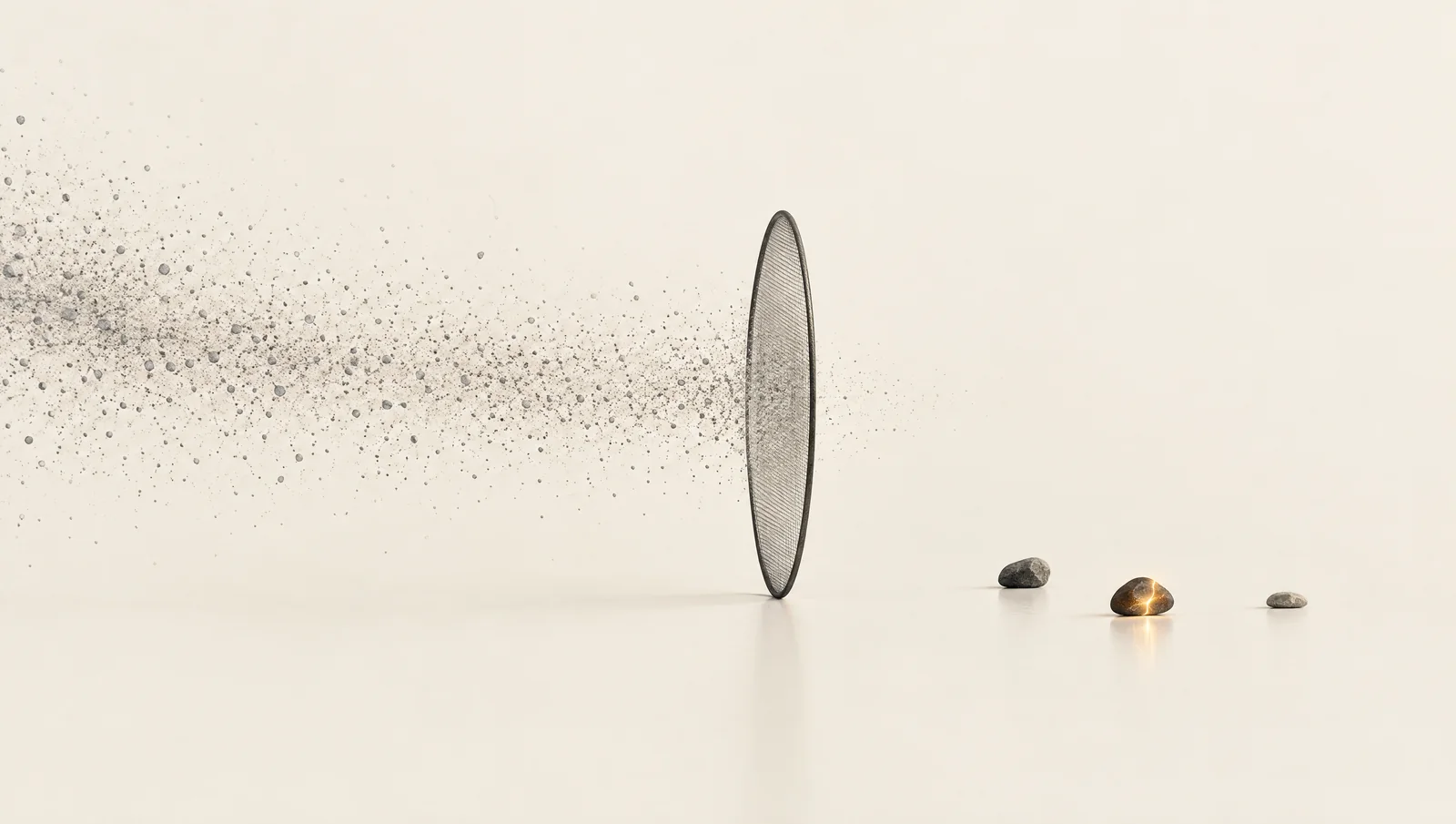
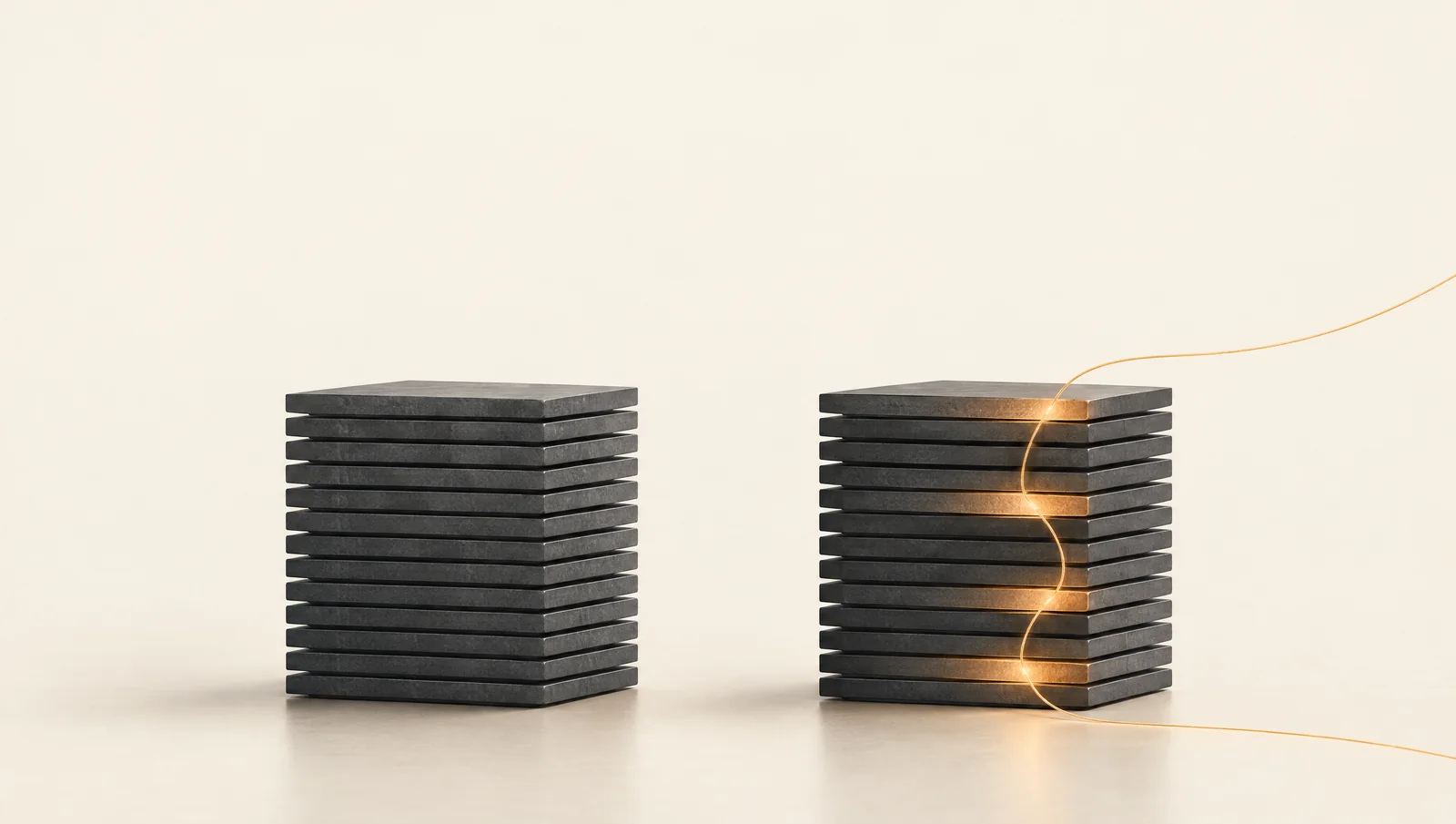
When people picture a good memory for an AI, they usually think of quantity: remember more, for longer, and let nothing slip. The idea is appealing. It also has a simple problem: a memory that keeps everything ends up looking like an attic where nobody can find anything.
Why keeping everything seems reasonable
The logic is clear. You never know what will matter later, so you record it. Storage is cheap, and forgetting hurts: everyone has lost a piece of information at the exact moment it became useful.
For simple use, that is often enough. If you work with a single AI on everyday topics, its native memory does the job, and we explain when it really is enough. Selection becomes a serious question once the story gets long: months of a project, several tools, decisions piling up on top of each other.
What a memory that keeps everything costs
The first cost is noise. Noise is whatever gets kept without ever helping to understand what comes next: an “ok, thanks”, a doubt resolved a minute later, a sentence rephrased ten times. Each item is harmless on its own. Piled up, they force every search to sift past them, and some end up looking like important memories.
The second cost is what we can call context debt: the buildup of information that is no longer true or no longer relevant, but stays available as if it were. “I’m at a hotel this week” is a temporary fact. Six months later, if it is still there, it does not say it has expired. It just waits to be believed.
The third is dilution. Handing an AI a lot of items is not the same as handing it the right ones. If two items matter out of twenty, the sorting work is simply pushed to the moment when nobody wants to do it, the moment of the answer. That is the idea behind the difference between memory and context: keep less, understand better, retrieve at the right moment.
What deserves to last and what can fade
We do not detail how Nawame makes this selection, and that is not the subject here. The principle, though, needs no technical background.
What is likely to help later is whatever gives a story meaning over time:
- a decision, and the reason it was made;
- an abandoned option, and why it was abandoned;
- a constraint, an observed result;
- a change of position, and what replaced the earlier decision;
- a question that is still open.
What can reasonably fade: pleasantries, intermediate attempts, successive wordings, facts that hold for a few hours only. The distinctions between these kinds of items are detailed in the difference between a memory, a fact, a decision, a hypothesis and an instruction.
The boundary is not always sharp. “I’m moving in September” is an anecdote in a conversation about a recipe and a major constraint in a hiring project. That is also why the topic of decisions that change is linked to this one: knowing what to keep already means knowing what may later become false.
An example: a week of work on a website
Imagine a freelancer, Claire, who is rebuilding her website with an AI over one week. What follows is an invented example, for illustration.
On Monday she hesitates between several fonts, tries four, then settles on one. On Tuesday she decides not to offer online payment at launch, because her bank is slow to open the service. On Wednesday she asks for ten rewordings of the same headline. On Thursday she mentions that she will not answer emails before 2 pm, this week only. On Friday she thanks the AI and stops.
What deserves to last? Tuesday’s decision, with its reason: in two months, when Claire wonders why there is no buy button, that is the memory that will matter. The final font, yes, and perhaps why it was chosen. The three other fonts, the ten headlines, the email hours and the thank-you: no.
A memory that keeps everything would give every line of the week the same weight. A memory that selects makes Tuesday’s decision easy to find.
What Nawame adds
Nawame is context memory for humans and AI. It keeps decisions, reasons, changes and outcomes, and it takes a position that may be surprising: not everything deserves to become a lasting memory. Not writing is a feature. When a memory refrains from writing, it is neither a lapse nor a failure, it is a design choice, just like what it does write.
Nawame does not memorize everything, and we prefer to say so plainly. What it keeps stays in your personal memory, private and encrypted, hosted in Europe, and the compatible AI tools you authorize (ChatGPT, Claude, Mistral, Grok and others, depending on the connections offered) can refer to it. The details are on the security page.
What we have measured
Our first synthetic not-writing protocol correctly classified 26 events out of 26; real life will be more complicated.
Here is what that means. “Synthetic” means the events were made up for the test, with the expected answer known in advance. It shows that the principle can be checked. It does not show that everything will go as well on your real conversations, which are ambiguous, unfinished and mixed together. The work continues in the Lab, the laboratory of memory and context, and we do not publish the protocol in detail. A method for building a test like this yourself is described in how to test non-writing.
Current limits
- The boundary is blurry. What is trivial for one person is decisive for another. A selection that suits one project can be wrong for the next.
- Selection can go wrong in both directions. Writing what will never help creates noise. Not writing what would have helped is worse, because it is invisible: you cannot see what is missing. Nawame does not guarantee that it keeps everything important.
- A synthetic protocol is not real life. The result above is a starting point, not proof of robustness.
- Judgment stays human. If a piece of information matters to you, say so explicitly instead of waiting for it to be guessed.
- Sometimes a simpler solution is enough. A well-kept document or the native memory of a single AI covers a short project or light use perfectly well.
How to apply this idea today, with or without Nawame
Before saving something in any memory (yours, a notebook, an AI tool), three quick questions are enough. Will it matter in several months? Will it still be true? Does it explain a decision? If the answer is no every time, do not keep it. And if a fact is temporary but useful, write its duration with it: “until Friday”. For a meeting, the same grid is applied in what AI should remember from a meeting.
If you want to see how this works in practice, the free plan lets you start with your first memory.