Memory & Context
AI memory vs context: storing information is only half the problem
Short answer
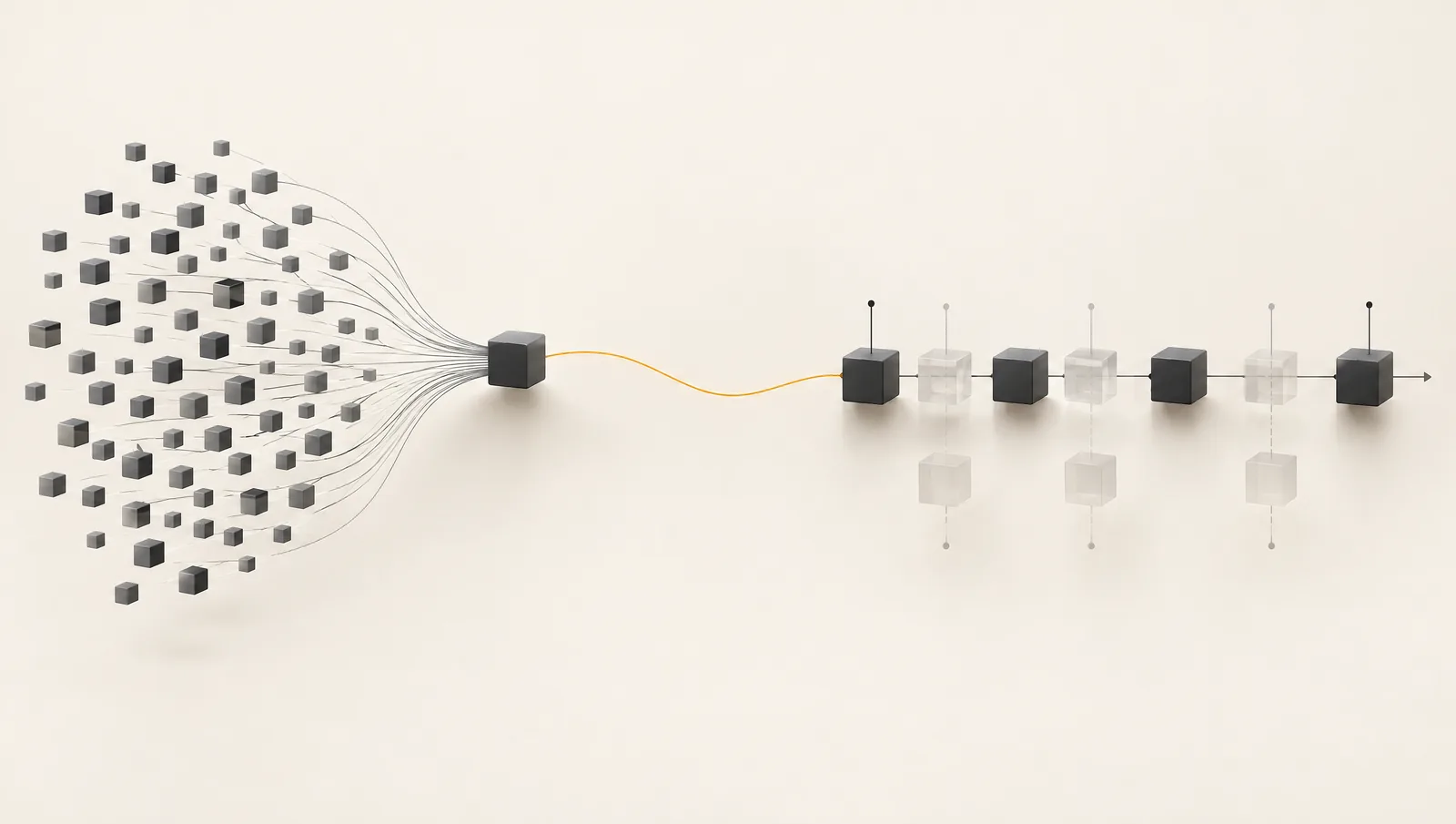
AI memory stores information. Context says how that information fits together: when it dates from, where it comes from, whether it still holds and why it matters. Storing without that work quickly produces a pile of notes where old and new sit side by side, and where an outdated decision can pass for the current rule.

When people say an AI “has memory”, they usually mean it keeps things: your preferences, the name of your project, a few facts about you. That is useful, and already far more practical than a conversation that starts from zero every time.
But keeping is not understanding. A memory can hold a thousand accurate notes and still give you a bad answer, because nobody taught it what connects those notes to each other. This article separates the two problems: storing on one side, providing context on the other.
What “AI memory” means today
“AI memory” usually refers to a mechanism that keeps information from one conversation to the next. Some of it is saved automatically by the tool, some of it is added by you. It is then brought back into later exchanges.
That is the storage function, and it answers a real need: not having to repeat your job, your tastes, the names of your colleagues. For stable, personal facts, it works well.
The difficulty begins when the information is no longer a stable fact but the trace of work that evolves: decisions that replace others, options tried and then dropped, rules that hold until a certain moment.
Context: what gives meaning to what is stored
Context is the set of elements that make it possible to interpret a piece of information: when it was recorded, by whom, for what reason, what it replaced, and what has happened since. A note on its own says “what”. Context says “why”, “since when” and “is it still true”.
Imagine a small editorial team that wrote down in January: “We send the newsletter on Monday.” In June, after a few weeks of poor open rates, it decides to move to Thursday. If the memory keeps only the first note, it will answer “Monday” with perfect confidence. If it keeps both without linking them, it may answer at random.
What is missing is not one more piece of information. It is the relationship between the two: the second replaces the first, here is the reason, here is the date. A memory that stores without that link looks like a drawer of undated notes.
Five questions a useful memory must handle
For a memory to really serve your work, it has to deal with at least five questions. The first three are technical, the last two are the ones most often forgotten.
Storing
This is the foundation: keeping the information, reliably and under your control. Without it, nothing else is possible.
Retrieving
Keeping is pointless if you cannot find the right thing at the right moment. Semantic search, which looks for meaning rather than exact words, is the most common approach. It is powerful, and it has a known flaw: it can connect two situations that look alike without being comparable. We come back to this in the article on the false precedent. How this differs from a system that answers from documents is laid out in AI memory vs RAG.
Placing things in time
Information without a date is ambiguous. Temporality means knowing what was true at which moment, and in what order things happened.
Recognizing what is outdated
A replaced decision stays in the history, and it is useful to have access to it. But it must not be presented as the current rule. Telling it apart from information that still holds requires keeping the trace of the replacement, not just the content. The signals that give away an outdated memory are listed in how to tell that a memory has become obsolete.
Keeping provenance
Where does this information come from? Did you write it, was it imported, does it come from an official document? Provenance lets you gauge how much to trust it. A note imported from an old tool does not have the same status as a decision validated by your team.
Keeping less to understand better
People often assume a good memory keeps everything. More often the opposite holds.
The more you store, the more noise you retrieve: platitudes, temporary facts, drafts that never went anywhere. An overfull memory answers worse than a smaller, better chosen one. Not writing (choosing not to keep what does not deserve to last) is therefore not an oversight, it is a feature in its own right. We cover it in detail in why a good memory knows when not to write.
The same principle applies at retrieval: giving the AI fewer items, but the right ones, helps it more than dumping everything that might be relevant (the overloaded prompt case is covered in giant prompt or targeted context). Keep less. Understand better. Retrieve at the right moment.
When a simple memory is enough
A pure storage memory is often the right answer. It is enough if your information is stable (your preferences, your way of working, facts about you), if you use a single assistant, or if the subject is small enough that a document you reread covers the whole history.
In those cases, adding a layer of context would bring little and complicate things. Your assistant’s native memory, or a simple page of well-kept notes, is then worth more than one more tool.
What Nawame adds
Nawame is a context memory for humans and AI. Beyond keeping things, it holds what gives meaning to a story: the decision and its reason, the abandoned option and the reason it was dropped, what replaced what, the observed result. Information is kept with its temporality and provenance, and imported information stays identified as such without automatically becoming a reference.
When an AI you have authorized searches this memory, it can report a precedent found, a possible connection, or no convincing precedent. Found does not mean true: the result keeps the date, the origin and the context so you can judge.
Nawame provides context, and the decision stays yours. That is also the point of a memory that is separate from the tool: your tools change, your story stays. If you want to see what this looks like on a specific case, the article on what a good prompt cannot contain works through a concrete example.
Current limits
This approach has a cost. Keeping context means keeping more than a simple list of facts, and you have to decide what to keep. Nawame does not memorize everything, and something judged unimportant at the time can turn out to be useful later. Our first synthetic non-writing protocol correctly classified 26 events out of 26; the real world will be more complicated.
The hard problems remain whole: false precedents, noise, choosing which context to provide, handling time, portability. We do not present them as solved. The Lab studies and measures them.
Finally, a context memory is only worth what you put into it. If nobody ever records a decision, it will not find it. And some privacy choices, such as sovereign mode, limit capabilities that require understanding the content on the server side. Answers to these practical questions are gathered in the FAQ.
How to choose for your situation
Ask yourself three simple questions.
- Does my work stretch over months, with decisions that replace others?
- Do I use, or could I use, several AI tools?
- Have I ever found myself redoing a choice I had already settled?
If you answer no to all three, a simple memory is probably enough. If you answer yes to one or two, the question of context deserves to be asked. Nawame is free for up to 10 memories, with export and sovereign mode: you can start free on a single subject before deciding.