Lab
Should AI memory be rewritten for machines?
Short answer
Should a memory designed for AI look like a document designed for people? We investigated this by building an experimental representation made of structured assertions. It helped with specific facts, but weakened some connections needed for synthesis. That difference changed what we looked for next.
The idea began with the structure of meeting notes
A meeting record follows the discussion. A question asked later follows a need. A supplier decision may sit between a scheduling issue and a comment about equipment. The document title may offer little help in finding it.
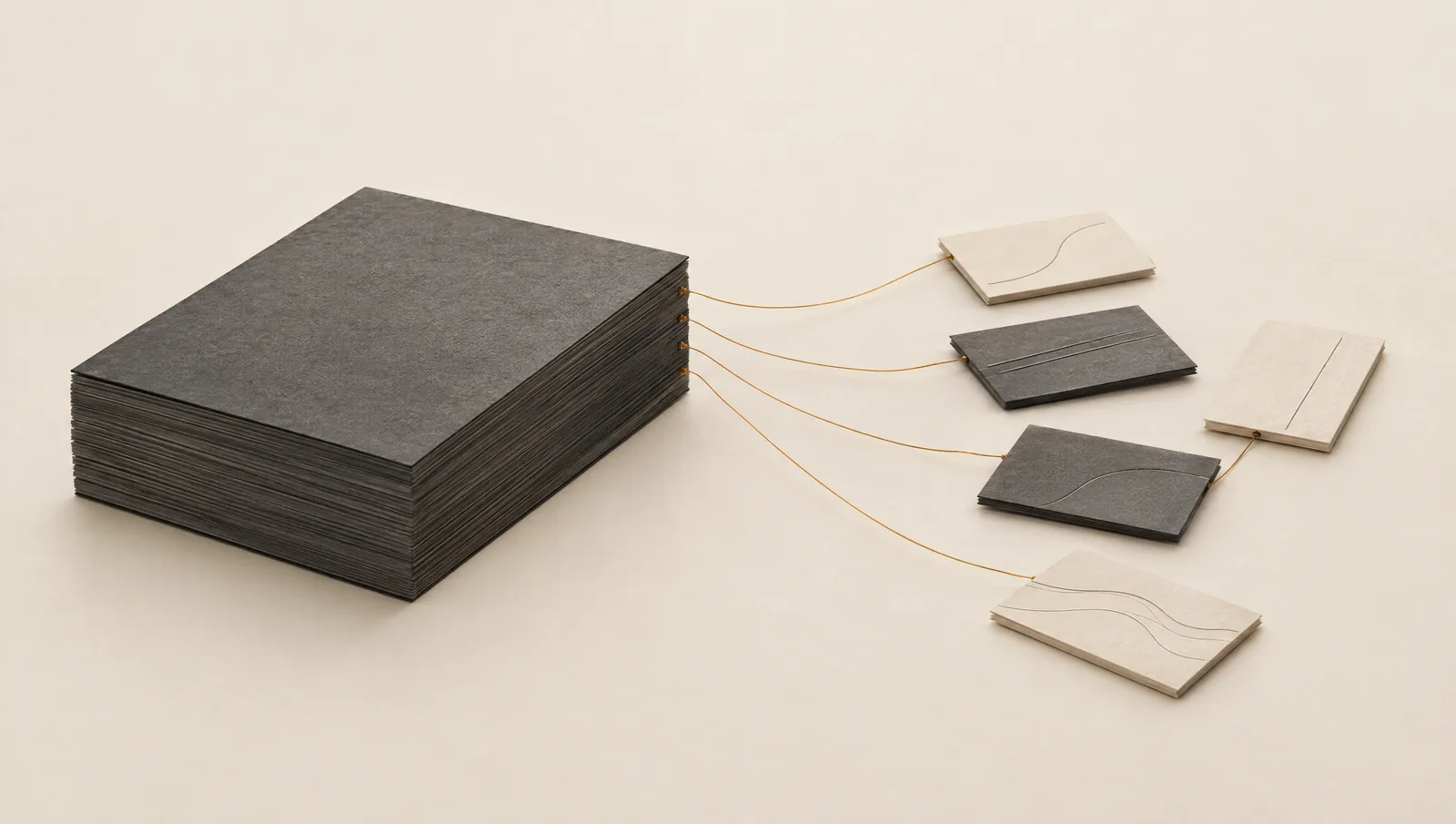
The Lab hypothesis was to preserve human-readable memories and derive assertions from them: what is being discussed, what value is stated, who said it, when it applies and what status it has. Each assertion had to remain connected to a verifiable quotation. The machine view was a research object, with no independent authority over its sources.
Testing against the real baseline
The first campaign compared Nawame’s actual code, retrieval improvements within its existing architecture and an assertion space. The fictional corpus contained six development worlds and eight test worlds, with about 265 notes per world. Two families of response models were used. The benchmark embedding model substituted for the production model, which limits the comparison.
The primary candidate selected before testing failed the success criterion. A secondary variant gained 1.08 points on a partial score out of 10 with a 1,200-token context budget. Two qualifications matter: human control was absent from the score, and comparing several variants increases the risk of selecting a chance success.
A control that changed the explanation
At a 2,500-token context budget, the variant’s gain fell to 0.17 points, with no statistically established difference. An additional control, introduced after inspecting the results, also exposed the influence of paraphrasing. On the same worlds without artificial paraphrasing, the gain was 0.36 points.
The initial advantage therefore did not establish the general superiority of a new memory architecture. Much of it came from compressing long, reformulated notes. That ability can be useful, but it addresses a narrower problem than replacing the architecture.
Finding a fact and preparing a handover differ: scope and limits
Assertions helped with revised values, effective dates and reasons for a change. They were less successful at handovers drawing on several sources. Breaking information into smaller units can improve access while weakening relationships that make a case understandable.
Transformation also created a trust problem. Rewriting could give suspicious material the appearance of an official assertion. Proving that a quotation exists does not prove that its interpretation is faithful. A source may contain a proposal, a report of someone else’s words or a claim that should never have been treated as authoritative.
The consequence: isolate the useful mechanism
This experiment led us to study granularity, wording, time and context selection separately. A derived representation needs a route back to its source. People must be able to challenge it, and access rights, corrections and deletions must continue to govern its use.
That first campaign left us with a durable research rule: before replacing memory, identify the exact difficulty the new representation solves, then measure what it loses. Preserving decisions and their reasons remains the objective. Multi-step retrieval investigates another way to reach that information without assuming a replacement architecture is necessary.
Related reading: AI memory vs context: storing information is only half the problem and Importing memory without importing hallucinations.