Memory & Context
AI memory vs RAG: they are not the same thing
Short answer
RAG mainly retrieves relevant information from a corpus. AI memory maintains context associated with a user, project or organization over time. Both can use embeddings or vector databases, but memory usually adds temporal validity, identity, updates and lifecycle management.
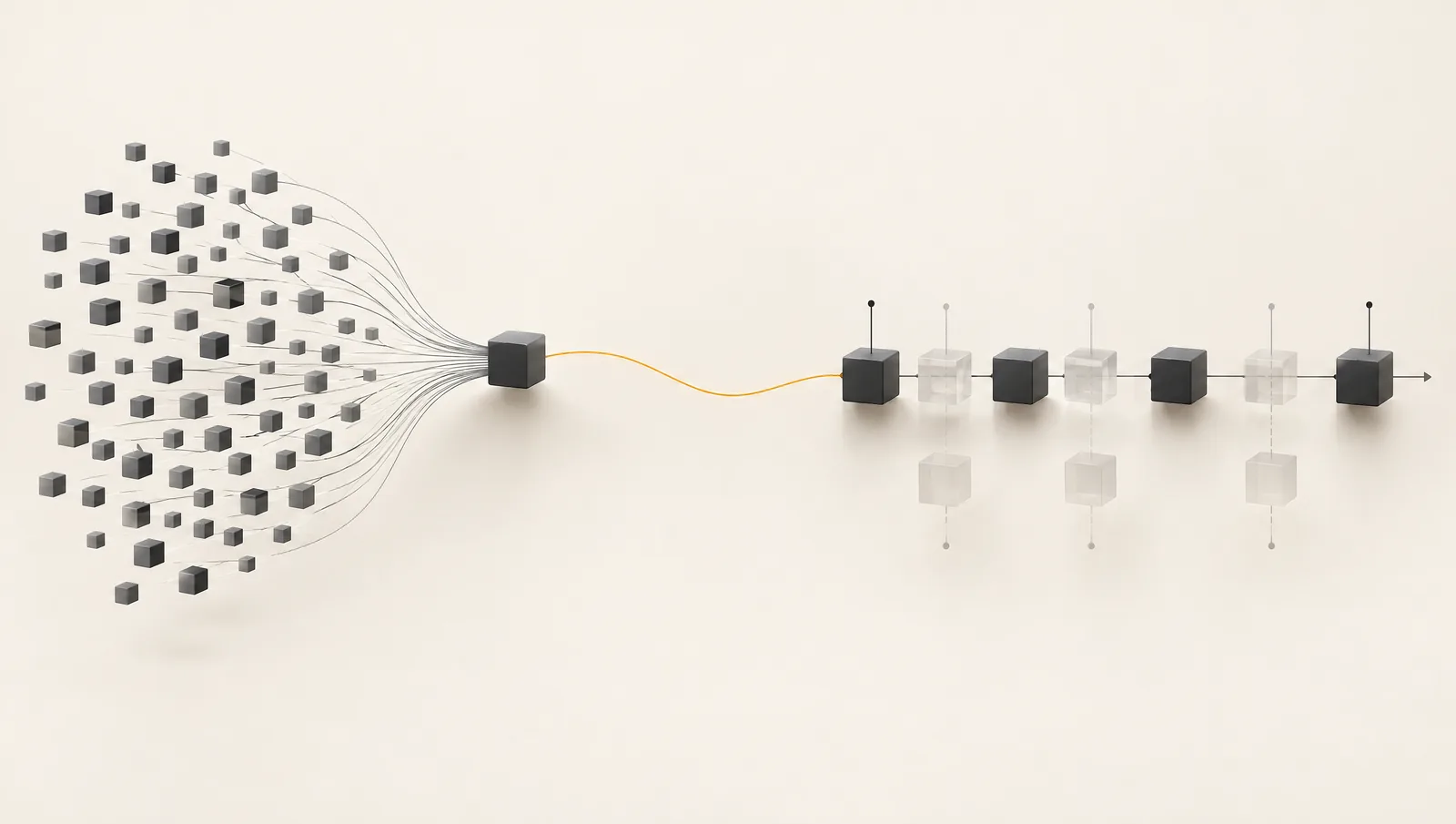
RAG and AI memory are often confused because both can perform the same technical action: retrieve information before generating a response. They still solve different problems.
RAG mainly asks:
Which information from my corpus is relevant to this question?
Memory asks something closer to:
What is still true, useful or important in the ongoing history of this person, project or organization?
RAG enriches an answer with knowledge
A typical RAG system starts with a corpus: documentation, procedures, contracts, articles, files or support tickets. When a question arrives, the system retrieves relevant passages and gives them to the model.
This is excellent for:
- answering from documentation;
- citing a procedure;
- locating a precise fact;
- querying more text than fits in the context window;
- reducing hallucination by supplying source material.
The document exists independently from the person asking the question.
Memory tracks state over time
Long-term memory introduces problems that retrieval alone does not automatically solve:
- Is this information still current?
- Has it been replaced?
- Is it personal or shared?
- Is it a fact, preference, decision or hypothesis?
- Who provided it?
- What happened after the decision?
- Should it be forgotten?
Time becomes part of the meaning.
A concrete example
Your documentation says:
Deployments happen on Friday.
A RAG system can retrieve that sentence perfectly.
But two weeks ago, the team moved deployments to Tuesday after several incidents. A maintained memory should know that the Friday rule is historical, or at least flag the contradiction.
The problem is no longer document relevance. It is current validity.
A vector database is neither RAG nor memory
A vector database is a retrieval component. It helps find items that are semantically close to a query.
You can use one for RAG, memory, similarity search or many other tasks.
Calling a vector database “memory” is like calling an index the application that uses it.
When to combine RAG and memory
The two are often complementary.
To prepare a client response:
- RAG can retrieve the contract, procedures and product documentation;
- memory can retrieve decisions made with that client, constraints, previous incidents and open commitments.
General knowledge comes from the corpus. Continuity comes from structured history.
The failure modes are different
Bad RAG may return a weakly relevant document.
Bad memory may return an old fact as if it were still current. That can be harder to notice because the answer may sound perfectly coherent.
Memory therefore needs evaluation beyond retrieval rate: obsolescence, contradictions, provenance, scope isolation and the ability to abstain.
Which system do you need?
If your main problem is “my AI does not know my documentation”, start with RAG or document search.
If your main problem is “my AI forgets what we decided, why we decided it and what changed since”, you have a memory problem.
If you have both problems, you will probably need both systems.
The question of validity over time connects to AI memory vs context and when a decision changes, what happens to the old one?. The risk of an old memory presented as current is detailed in why found does not mean true, and that of a resemblance mistaken for a precedent in when semantic search invents a false precedent. For the limits of retrieval at scale, see limits of retrieval at scale and the Lab. To choose between the three building blocks, read RAG, vector database or AI memory: which one do you need?.
Limits of this distinction
The line is not watertight: one system can combine retrieval and state management, and products keep evolving. The vocabulary is not fixed either, and some providers call “memory” what is mostly retrieval. Judge a tool by what it actually does about validity, provenance and permissions, not by its label.